Liquid sloshing in partially filled tank trucks is a critical safety concern in the transportation industry. During braking, the liquid cargo shifts forward, generating dynamic forces that affect vehicle stability, increase braking distances, and can lead to rollover incidents. Baffles are commonly installed inside the tank to suppress these oscillations, but their effectiveness depends on the design and the severity of the maneuver. Simulation allows engineers to evaluate baffle configurations virtually and quantify their impact on sloshing forces before physical prototyping. shonDy’s sloshing capabilities have been validated against experimental data in a dedicated case study on this website.
Case Description
In this case study, an emergency braking maneuver of a loaded tank truck from 80 km/h to a full stop is simulated. Rather than moving the tank geometry through space, a gravity-based approach is used: leveraging the equivalence principle, the braking deceleration is represented as a time-dependent change in the gravity vector. In the co-moving (truck) reference frame, the liquid experiences a pseudo-force equivalent to the braking deceleration, which is physically identical to tilting the gravity vector forward.
The effective gravity vector during braking is:
where is the time-dependent braking deceleration profile. The driving direction is defined as the negative x-direction , so the fluid shifts toward during braking and positive x-displacements correspond to rearward motion.
Braking Profile
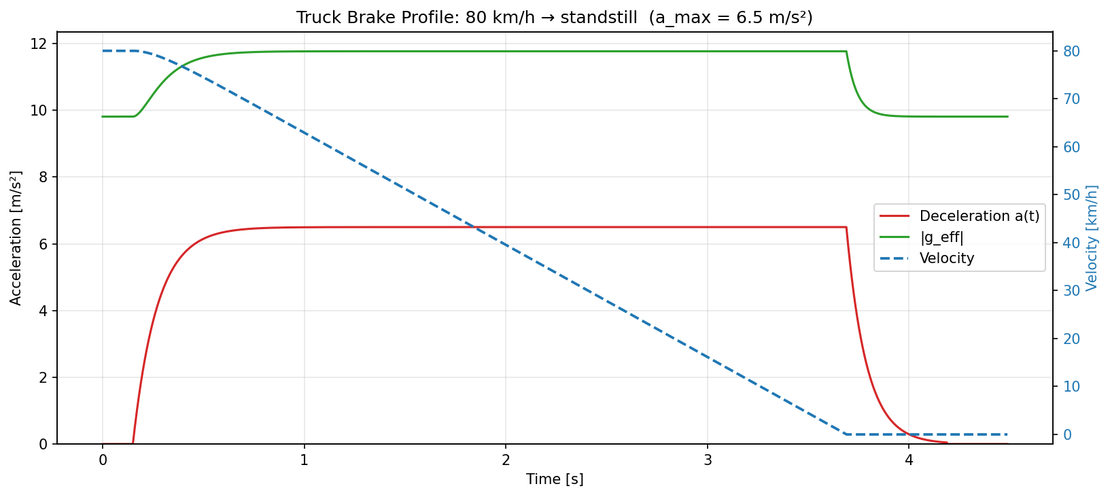
The braking profile was designed to represent the pneumatic braking system of a loaded truck and is shown below:
At peak braking, the effective gravity vector has a magnitude of approximately 11.77 m/s² (1.20 g) and is tilted by ~33° from the vertical.
Geometry
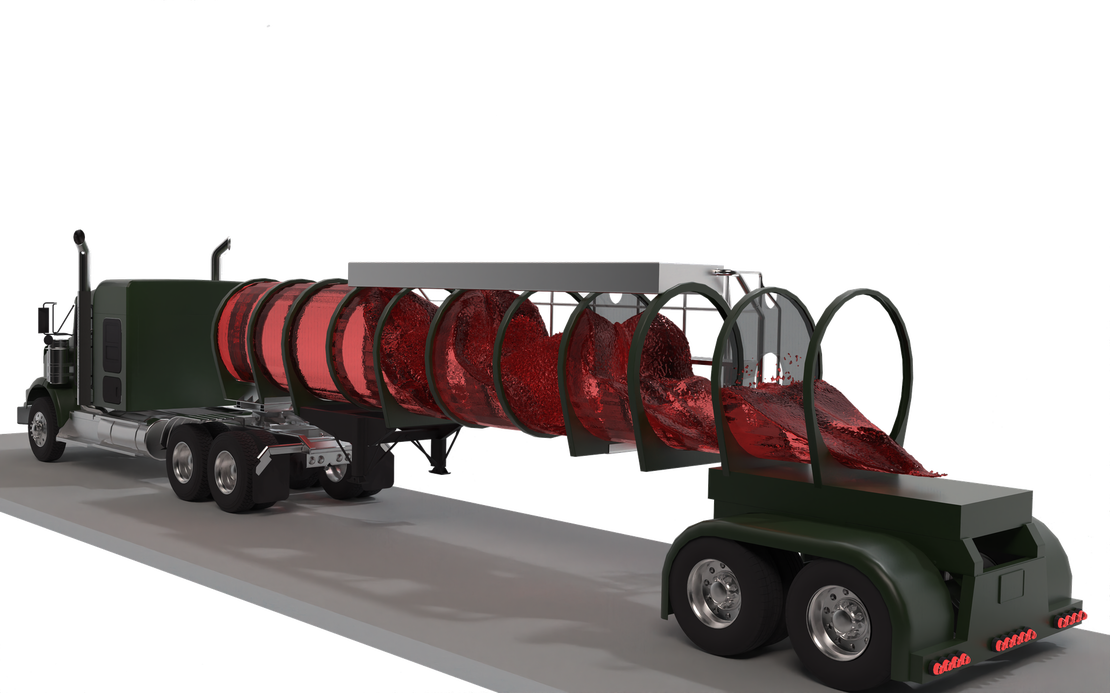
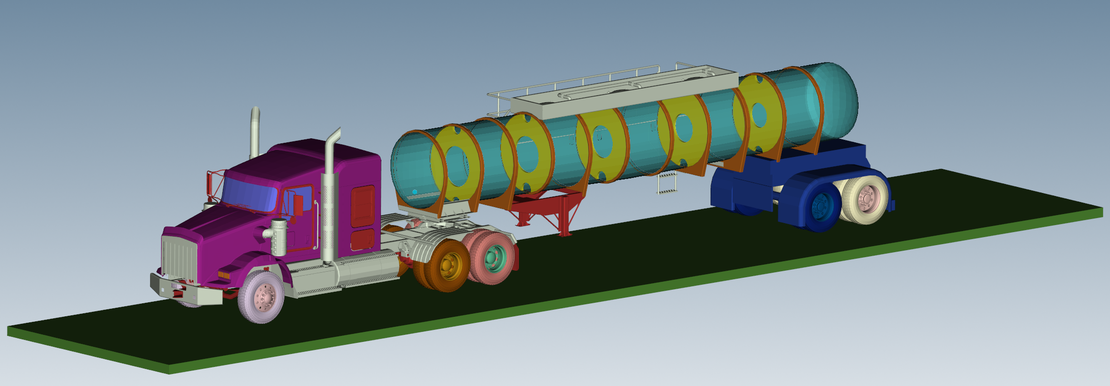
The tank is 11.5 m long with a cross-sectional height of 1.6 m. Note that only the tank and the baffles are geometrically relevant for the simulation. The truck body is included solely for orientation (driving direction) and to provide a clearer visualisation of the overall setup.
Two configurations were set up for comparison:
- Without baffles: An unobstructed tank interior, representing the worst-case scenario for sloshing.
- With baffles: Internal partition walls dividing the tank into compartments, reducing the free sloshing length.
The geometry of the baffled configuration is shown in the image below.
Case Set-Up
The truck is loaded with 10 m³ of liquid at a density of 884 kg/m³, giving a total fluid mass of 8,840 kg. The simulation uses a particle radius of 6 mm, resulting in approximately 5.8 million particles. The total simulation time is 15 seconds, covering the full braking event and the subsequent post-braking sloshing phase.
| Parameter | Value |
|---|---|
| Fluid Density | 884 kg/m³ |
| Fluid Volume | 10 m³ |
| Kinematic Viscosity | 16 cSt |
| Particle radius | 6 mm |
| Particle count | ~5.8 million |
| Simulation time | 15 s |
| Start velocity | 80 km/h (22.22 m/s) |
| Max. deceleration | 6.5 m/s² (0.66 g) |
Results
Overview
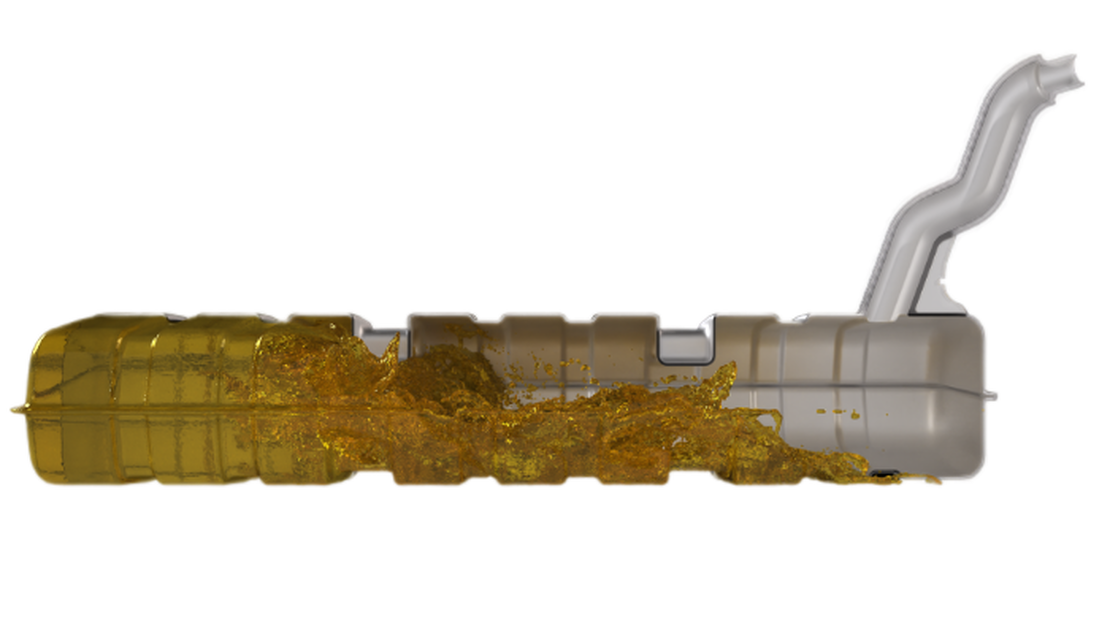
The videos below show the braking maneuver for both tank configurations. During the 1-second dead time, the fluid remains at rest. As the braking force ramps up, the liquid surges toward the front wall. In the tank without baffles, the full fluid mass impacts the front wall as a coherent wave. In the baffled configuration, each compartment contains a smaller volume, and the wave heights are visibly reduced.
Center of Mass Displacement
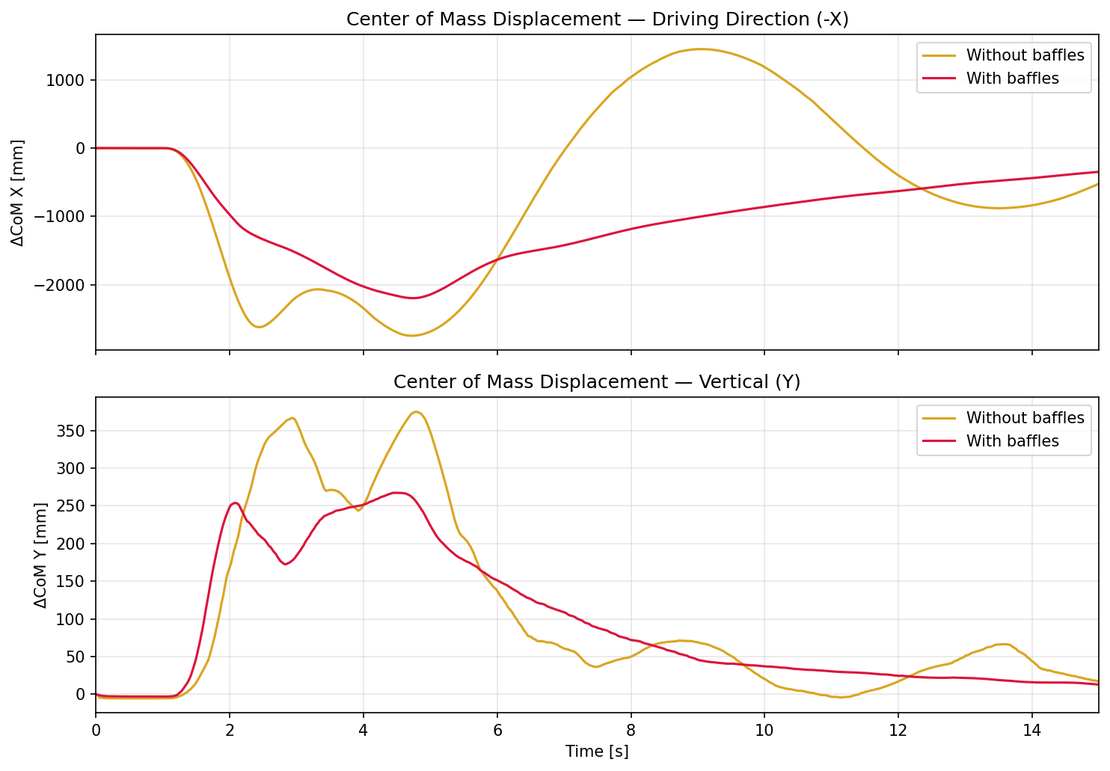
The center of mass (CoM) of the fluid was tracked over time in both the driving direction (x) and the vertical direction (y). The displacement is shown relative to the initial position at rest.
Once the vehicle reaches standstill, the braking force disappears but the kinetic energy stored in the fluid is not immediately dissipated. The liquid continues to slosh back and forth inside the tank, producing post-braking oscillations that persist for several seconds and generate alternating forces on the tank walls even at zero vehicle speed. The amplitude and decay of these oscillations are directly visible in the plots below as sustained oscillatory motion after the braking phase ends.
In the driving direction, the CoM without baffles reaches a maximum forward displacement of 2,750 mm. With baffles, this is reduced to 2,199 mm, a 20% reduction. Post-braking oscillations also decay significantly faster in the baffled configuration. To quantify this, the standard deviation of the CoM X displacement is computed over all time steps after standstill (t > 4.7 s). A larger standard deviation indicates stronger, longer-lasting oscillations. Without baffles, this value is 1,185 mm; with baffles, it drops to 500 mm, a reduction of 58%.
In the vertical direction, the CoM rises by up to 375 mm without baffles as the fluid climbs the front wall. Baffles limit this rise to 267 mm, a 29% reduction. A lower vertical CoM displacement directly reduces the effective center of gravity during braking, which is a critical factor for rollover stability.
Center of Mass Velocity
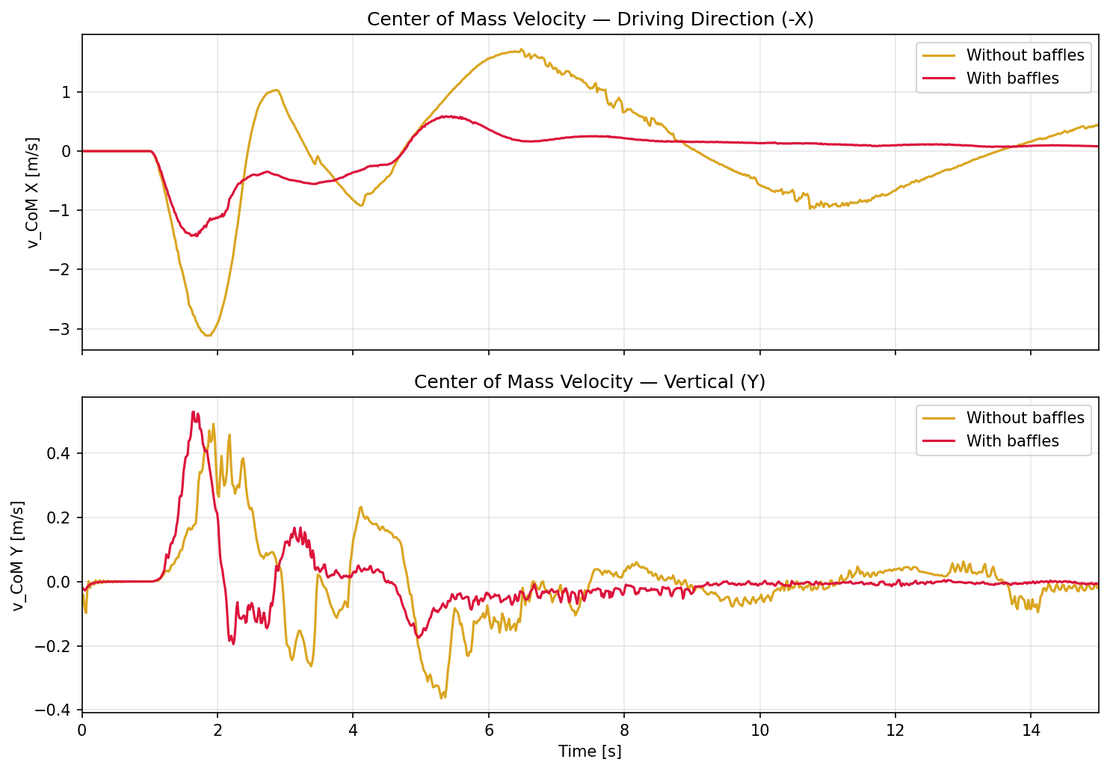
The first derivative of the CoM position provides the sloshing velocity, indicating how fast the fluid mass shifts inside the tank.
Without baffles, the CoM velocity in the driving direction peaks at 3.12 m/s. Baffles reduce this peak to 1.44 m/s, a reduction of 54%. The baffled configuration also shows markedly faster decay of the post-braking velocity oscillations, confirming the damping effect of the internal partitions.
Sloshing Force
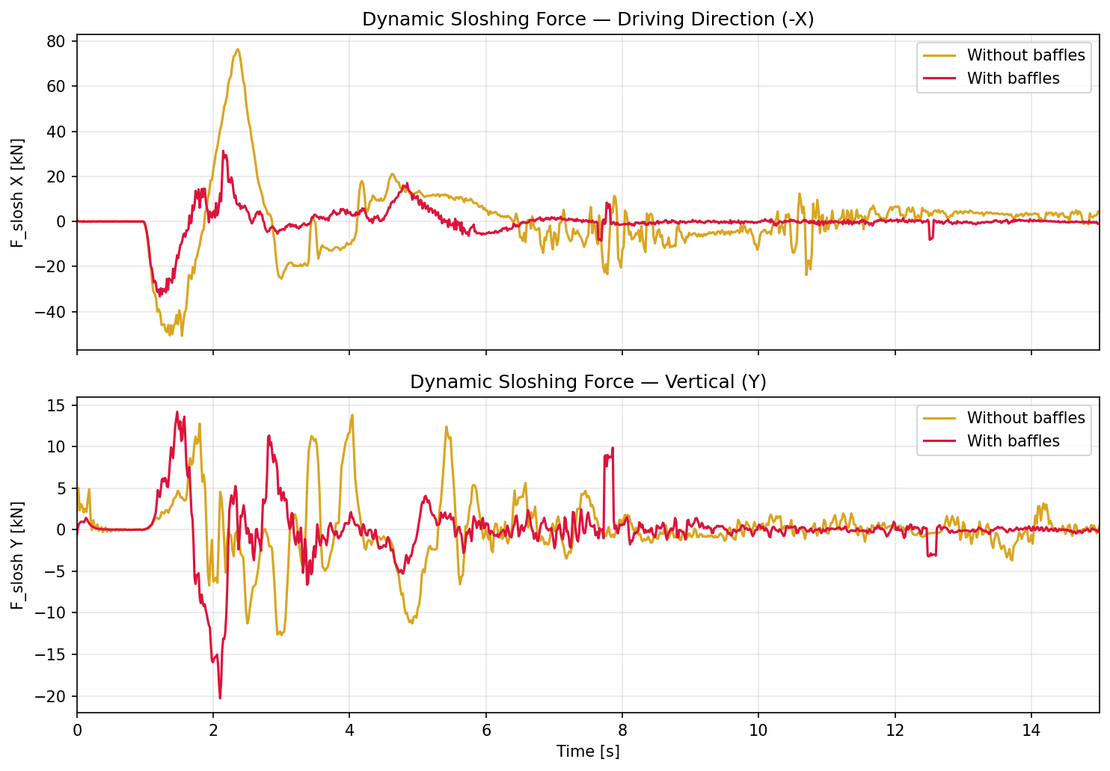
From the smoothed CoM acceleration, the dynamic sloshing force was computed as , with a fluid mass of 8,840 kg. This force represents the additional dynamic load the sloshing fluid exerts on the tank structure beyond what a solidified (rigid) mass would produce.
A sign change in this force indicates the reversal of the sloshing wave: as the fluid bounces off the front wall and begins moving backward, the dynamic sloshing force changes direction. These alternating forces are precisely what makes sloshing dangerous. They can excite vehicle dynamic modes and degrade handling stability.
The peak sloshing force in the driving direction reaches 76.5 kN without baffles. With baffles, this peak is reduced to 33.2 kN, a reduction of 57%.
Summary
| Metric | Without Baffles | With Baffles | Reduction |
|---|---|---|---|
| Max. CoM displacement X [mm] | 2,750 | 2,199 | 20 % |
| Max. CoM displacement Y [mm] | 375 | 267 | 29 % |
| Max. CoM velocity X [m/s] | 3.12 | 1.44 | 54 % |
| Peak sloshing force X [kN] | 76.5 | 33.2 | 57 % |
| Post-braking oscillation amplitude X [mm] | 1,185 | 500 | 58 % |
In this case study, an emergency braking maneuver of a loaded tank truck was simulated using shonDy’s gravity-based approach. By modifying the gravity vector over time to represent the braking deceleration, the simulation avoided the need for moving the whole tank through space while remaining physically equivalent through the equivalence principle.
Two configurations were compared: a tank without internal structures and a tank with baffles. The results demonstrate that baffles effectively reduce the peak sloshing forces, limit the center-of-mass displacement, and accelerate the damping of post-braking oscillations. These improvements translate directly to enhanced vehicle stability and reduced risk of rollover during emergency braking.
The simulation approach presented here provides a practical and efficient method for evaluating tank designs and baffle configurations under realistic braking conditions, enabling engineers to optimize cargo tank safety without requiring physical prototyping.
Rendered Comparison
The video below shows a side-by-side rendered comparison of both configurations throughout the full braking maneuver. The upper half shows the tank with baffles, the lower half the tank without baffles. Key findings are overlaid directly in the video.
Case set-up
| Fluid density | 884 kg/m³ |
| Fluid volume | 10 m³ |
| Kinematic viscosity | 16 cSt |
| Particle radius | 6 mm |
| Particle count | ~5.8 million |
| Start velocity | 80 km/h |
| Max. deceleration | 6.5 m/s² (0.66 g) |