
Many industrial and infrastructure facilities, such as dams, wastewater treatment plants, and flood-protection structures, have enclosed inspection chambers, shafts, and balancing tanks that may partially fill with water during operation. To prevent flooding, pressure spikes, or structural damage, these spaces are often equipped with automatically triggered relief flaps or emergency outlets. When the water level or pressure reaches a critical threshold, these systems open automatically, enabling controlled water discharge and restoring safe operating conditions. This case study demonstrates how shonDy can be used to set up and simulate such a scenario.
Case Description
The simulated scenario addresses the rapid flooding of a closed service room, focusing on the rise in water level and the activation of an emergency relief system. The room is initially filled with water to a depth of 0.29 m.
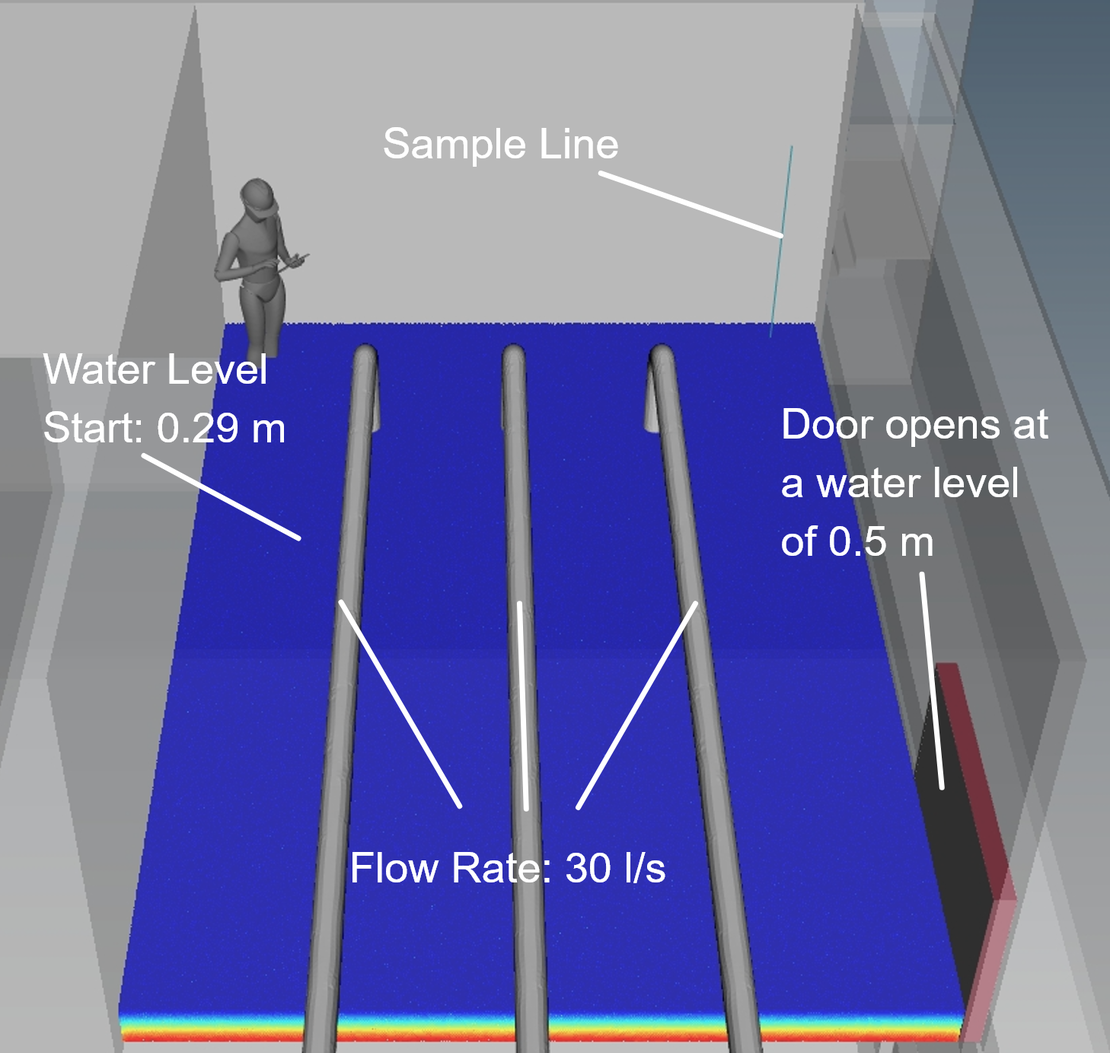
Flooding is initiated by a constant inflow of 30 l/s. As the water level continues to rise, it eventually reaches the activation threshold of 0.5 m, at which point the emergency relief flap opens automatically. This provides a controlled discharge path that leads to an immediate decrease in water level.
Results
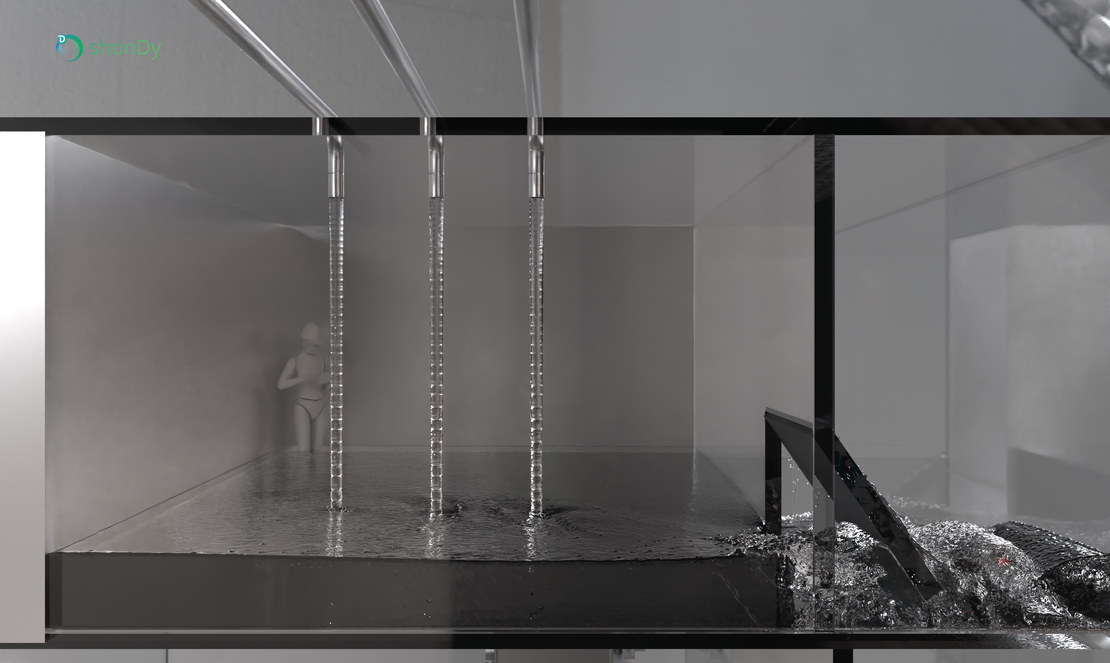
The rendered video below shows the transition from the filling phase to the drainage phase once the emergency relief flap is triggered.
Water Level History
The liquid level is monitored at a measurement point in the corner of the room, as shown in the first image. This location captures the global response of the system and provides a representative time history of the filling and drainage behavior.
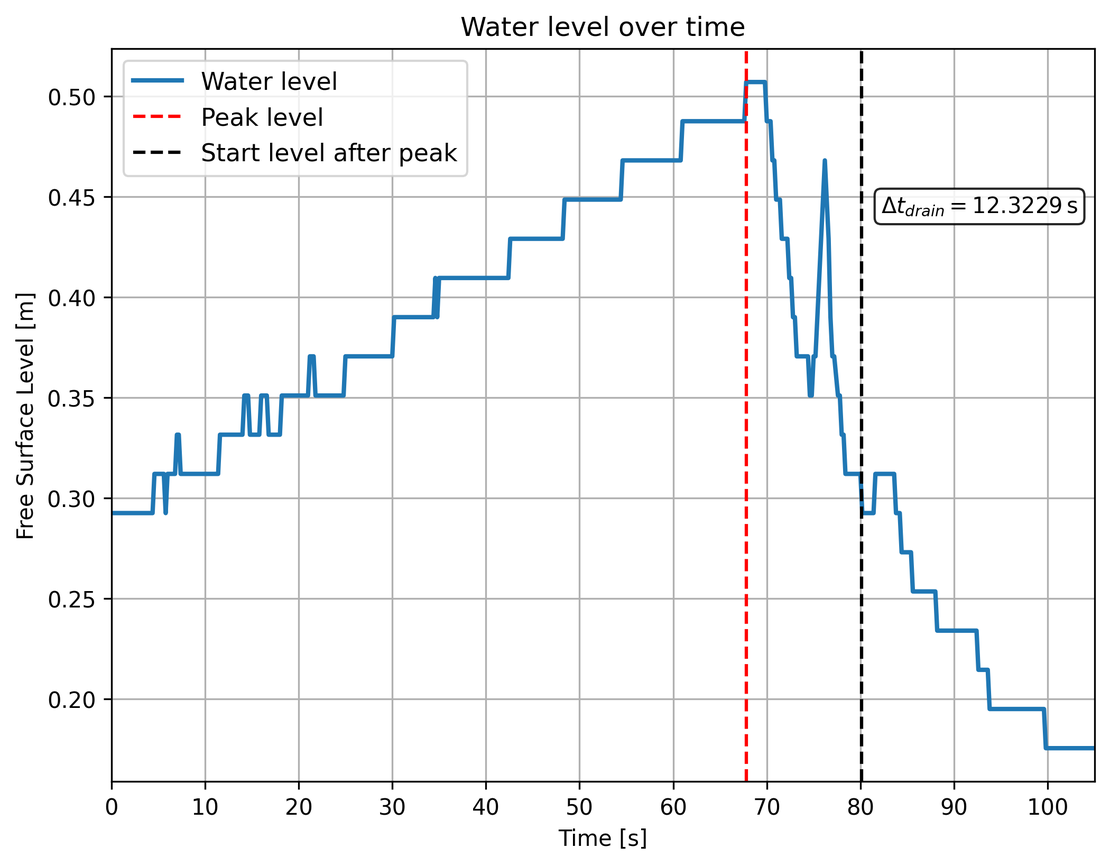
The figure illustrates the temporal evolution of the liquid level within the room. During the initial phase, the water level increases linearly as a result of the constant inflow, reflecting a steady and predictable filling process. This rise continues until the critical level of 0.5 m is reached, which corresponds to the activation threshold of the emergency relief system.
Once this level is exceeded, the emergency flap opens and the system transitions into a drainage phase, characterized by a rapid decrease in the liquid level. The drainage time , defined as the interval between the maximum liquid level and the return to the initial water level, serves as a quantitative measure of the system’s response efficiency.
Summary
This case study simulated the rapid flooding of a closed service room and the automatic activation of an emergency relief flap. The results show a clear two-phase behavior: a linear filling phase driven by the constant inflow, followed by a rapid drainage phase once the relief mechanism is activated. The drainage time quantifies the system’s response efficiency and can be directly extracted from the simulation.
These results demonstrate how shonDy can reliably simulate transient free-surface flows in confined spaces with triggered boundary conditions. This capability is directly applicable to the design and validation of emergency relief systems in infrastructure facilities, enabling engineers to assess response times, optimize activation thresholds, and evaluate discharge capacity before physical implementation.